
05 · Kaspa
How does Kaspa handle blocks that are created in parallel?
Kaspa uses Proof of Work.
Miners search for blocks, just as they do on other Proof-of-Work networks.
But information still takes time to travel between computers around the world.
One miner can find a new block, and before another miner hears about it, that second miner can also find a block built on the same earlier history.
Now two valid blocks exist in parallel.
Kaspa was designed to handle that situation differently from a traditional single-chain blockchain.
On a single chain, two blocks create two branches
In a traditional blockchain, each block continues from one previous block.
If two blocks are found from the same earlier history, two branches appear.
In Bitcoin, both branches can be valid for a short time.
As more work is added, the network follows the valid branch with more accumulated Proof of Work.
The other branch does not have to be fake or malicious.
It simply does not remain part of the main chain.
Kaspa can keep both blocks connected
In Kaspa, a new block can reference more than one earlier block.
That means a later block can connect to both blocks that were created in parallel.
Instead of immediately turning two valid blocks into competing branches where only one remains in the main history, both can stay connected.
That structure is called a BlockDAG.
An earlier block A appears, then two independently discovered blocks B and C, each referencing A. A later block D references both B and C. All four blocks remain connected. Arrows point from newer blocks to the earlier blocks they reference.
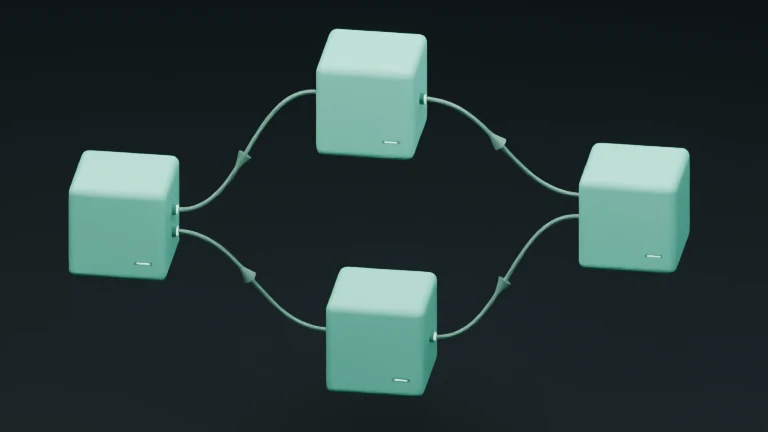
A BlockDAG is not one single chain
A traditional blockchain mostly looks like a line:
Block → Block → Block → Block
A BlockDAG can also contain parallel blocks, and later blocks can connect to several of them.
So the history looks more like a graph of relationships between blocks than one straight line.
But keeping both blocks still does not solve everything.
The network still needs an agreed order
Imagine one block contains:
Emma → Liam: 30 KAS
and a parallel block contains:
Emma → Olivia: the same 30 KAS
Both blocks can remain in the BlockDAG.
But both payments cannot be accepted.
The Nodes still need to reach the same order so they know which transaction is checked first.
GHOSTDAG gives the network a way to agree on that order
Kaspa uses GHOSTDAG to take the relationships in the BlockDAG and derive an agreed ordering.
It looks at the graph structure and the Proof of Work represented in it.
Nodes that have the same blocks can therefore reach the same way of ordering them.
In simple terms:
BlockDAG keeps work that happened in parallel connected.
GHOSTDAG helps decide how that connected history should be ordered.
After the order is determined, transactions still have to pass the normal validation rules.
GHOSTDAG does not make an invalid transaction valid.
What does Kaspa gain from this?
Because parallel blocks do not immediately have to become competing branches where only one remains in the main history, blocks can be created more frequently while more of the work done in parallel stays useful.
Kaspa currently targets 10 BPS - ten blocks per second.
That is roughly one new block every 0.1 seconds on average.
But 10 BPS does not mean “10 times more transactions”
BPS tells us how many blocks are created.
It does not tell us how many transactions are inside each block.
Different transactions can require different amounts of space, computation, and storage.
One simple illustration:
Kaspa’s published transaction-mass examples show that a block filled only with a common simple one-input, two-output transaction could fit about 245 transactions.
If all ten blocks in a second were completely filled with only that kind of transaction:
245 × 10 ≈ 2,450 transactions per second.
That is an illustration of the relationship between BPS and TPS - not a promise of 2,450 TPS in every situation.
In Bitcoin, a block filled only with simple transactions could hold roughly 7,000 transactions.
But Bitcoin targets roughly one block every ten minutes on average.
The point is that networks cannot be compared by block count alone or by transactions per block alone.
Both matter - and so do the requirements placed on the computers that verify the network.
More blocks also mean more work for Nodes
If more blocks are created every second, Nodes have to receive more blocks, verify more blocks, track more relationships, and stay synchronized.
So the question is not only:
“How quickly can blocks be created?”
It is also:
“How many people can still verify the network for themselves?”
That leads directly to Decentralization.
So what does Kaspa do differently?
Miners still use Proof of Work.
Blocks still have to be validated.
But blocks created in parallel can remain connected inside a BlockDAG.
GHOSTDAG gives them an agreed order.
That structure allows Kaspa to operate at a high block rate without requiring the entire world to hear about one block before the next one can be created.